



Do treści strony

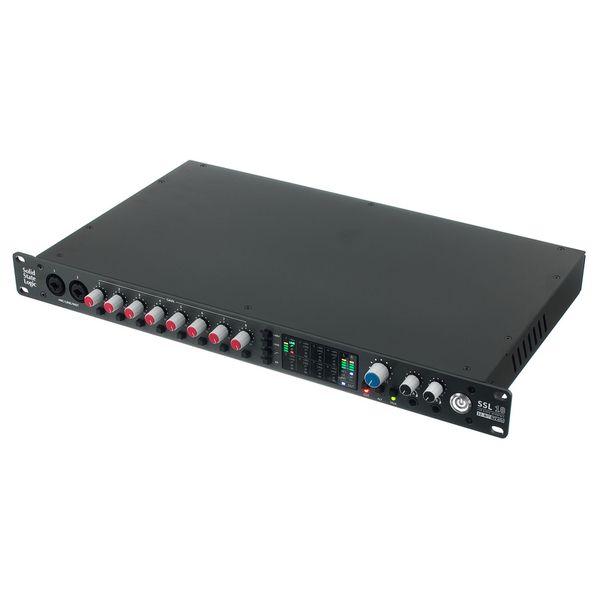
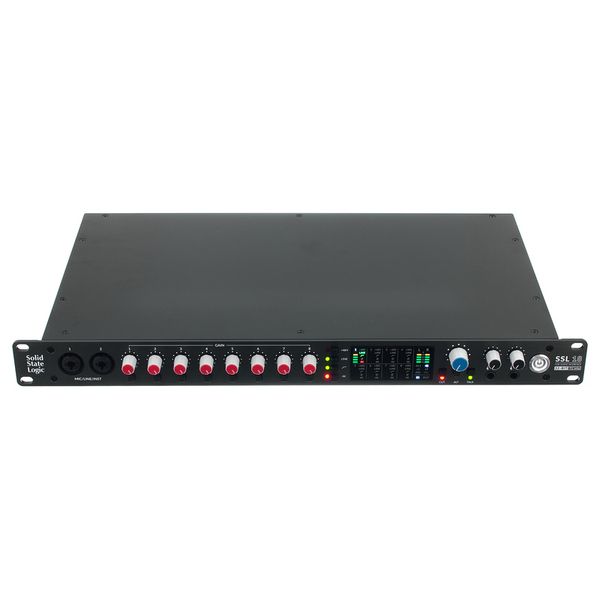
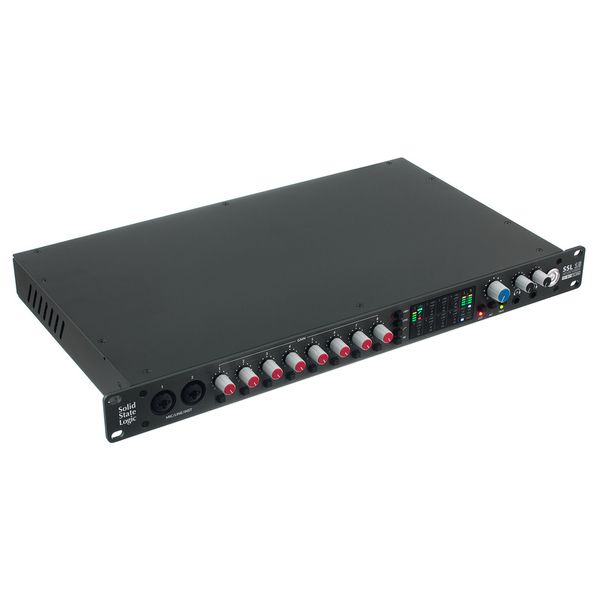
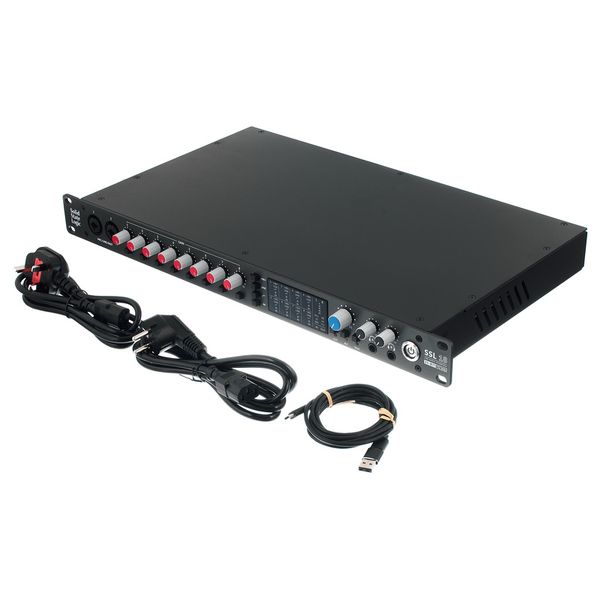
Interfejs audio USB 26 In / 28 Out

  • 32 bity / 192 kHz
  • Poziom pracy +24 dBu dla wszystkich wejść i wyjść
  • Dynamic Range 120 dB we wszystkich wejściach i wyjściach słuchawkowych
  • Dynamic Range 125 dB w wyjściach monitorowych i liniowych
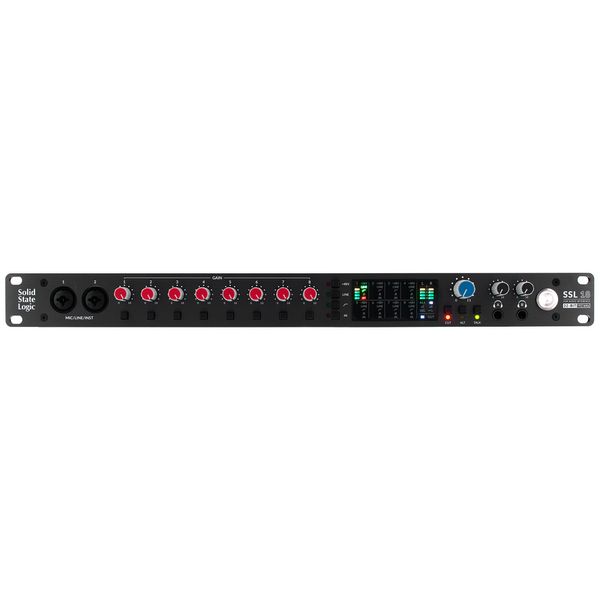
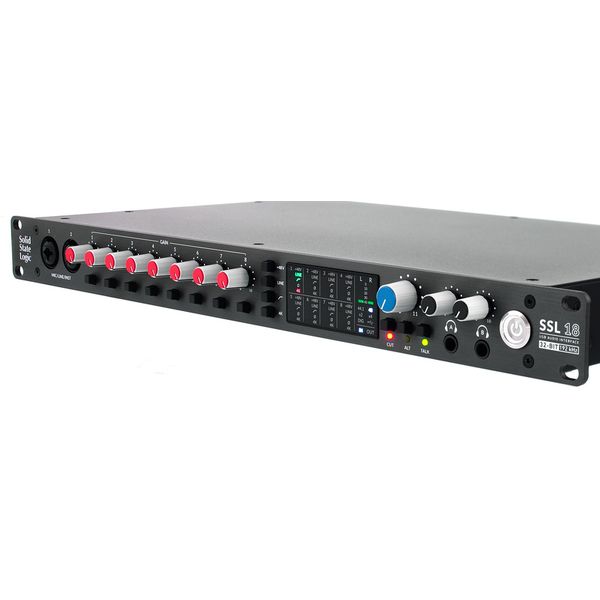
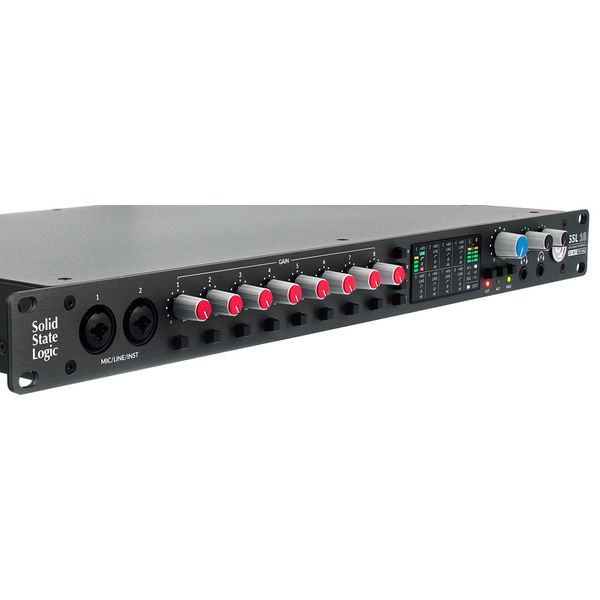
  • 8 przedwzmacniaczy mikrofonowych (Gain Range 67 dB, EIN -130,5 dBu, +48 V, Dynamic Range 120 dB, HPF, przełącznik 4K)
  • Wejścia 1/2 przełączane na poziom instrumentów
  • Wejście Talkback z wbudowanym Listen Mic Compressor (może być również używane jako wejście liniowe dla stemów z LMC)
  • Przełącznik Legacy „4K“ dla barwy dźwięku wzorowanej na serii SSL 4000
  • Stereo Loopback ze źródłem Loopbacku do wyboru
  • W zestawie oprogramowanie SSL Production Pack
  • Sterowanie przez bezpłatną aplikację SSL 360° (w tym SSL18 Low Latency Mixer Tool)
  • Wymiary (sz. x wy. x gł.): 482,6 x 43,6 x 294 mm
  • Waga: 4 kg

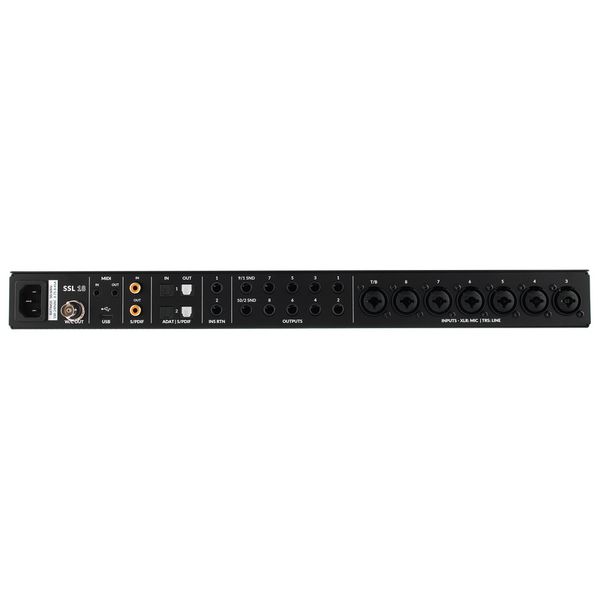
Złącza:

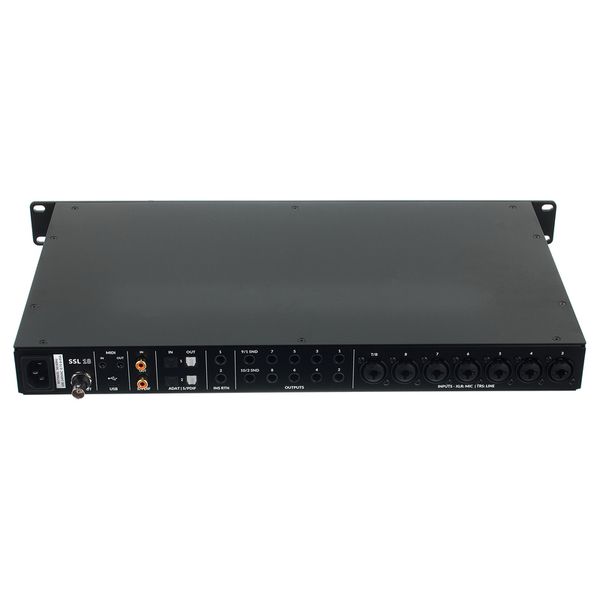
  • Wejścia kombo mikrofonowe / instrumentalne / liniowe: 2 x XLR / wtyczka jack 6,3 mm
  • Wejścia kombo mikrofonowe/liniowe: 8 x XLR / wtyczka jack 6,3 mm
  • Wejście kombo Talkback mikrofonowe: XLR / wtyczka jack 6,3 mm
  • 2 wejścia ADAT 44.1 / 48 kHz (8 kanałów @ 96 kHz)
  • 2 wejścia S / PDIF (koaksjalne lub optyczne)
  • Wejście Wordclock BNC
  • Wejście i wyjście MIDI: wtyczka mini jack TRS-A 3,5 mm
  • Wyjścia liniowe: 10 x symetryczna wtyczka jack 6,3 mm (+9 dBu / +24 dBu opcja dla wyjść 1/2 i 3/4, 9/10 Send)
  • Return: 2 x wtyczka jack 6,3 mm
  • Wyjścia słuchawkowe stereo - regulowane oddzielnie z 3 poziomami impedancji (Standard / High Sensitivity / High Impedance): 2 x wtyczka jack 6,3 mm
  • USB-C
  • Produkt dostępny od Marzec 2025
  • Numer artykułu 609316
  • Jednostka sprzedaży 1 szt.
  • Recording / Playback Channels 26x28
  • Number of Mic Inputs 8
  • Number of Line Inputs 8
  • Instrument Inputs 2
  • Number of Line Outs 10
  • Headphone Outs 2
  • Phantom power Yes
  • Number of S/PDIF Connectors 2
  • Number of ADAT Connectors 2
  • Numer of AES/EBU Connectors 0
  • Number of MADI Connectors 0
  • Ethernet 0
  • Other Connectors USB-C
  • MIDI interface Yes
  • Word Clock 1xIn
  • Max. sample rate (kHz) 192 kHz
  • Max. resolution in bit 32 bit
  • USB Bus-Powered No
  • Incl. power supply Yes
  • USB Version 2.0
  • Width in mm 482,6 mm
  • Depth in mm 294 mm
  • Height in mm 43,6 mm
  • Connection Format USB port Type C
  • Included in delivery SSL Production Pack Software
  • Zero latency monitoring Yes
3 799 zł
Ceny z podatkiem VAT
Dostępny za 1-2 tygodnie
1

20 Oceny klientów

4.8 / 5

obsługa

właściwości

dźwięk

wykończenie

12 Opinie

i
Great sound, enough I/O
iMuzaK 25.12.2025
For basic production and recording, this interface is excellent. If you need more inputs and outputs, the SSL Alpha 8 seems to be the right expansion path. The SSL 18 delivers good sound quality and a very pleasant working experience.

Once you finally set up the routing in the rather unintuitive SSL 360° software—which, to me, still feels like it is in a development stage—the workflow with physical knobs and buttons becomes a real pleasure.

What I like:
-The number of I/O is sufficient for my needs and can be expanded if necessary
-Dedicated physical knobs for each input
-Physical buttons, including talkback and ALT for a second pair of monitors
-Sound quality
-4K option, even though I do not use it all the time
-Zero-latency monitoring

What I don’t like:
- Counterintuitive SSL 360° software
- Buttons feel slightly wobbly
wykończenie
właściwości
obsługa
dźwięk
1
0
Zgłoś nadużycie

Zgłoś nadużycie

DN
I am disappointed
Dawid Nowak 07.04.2025
EDIT: I ordered a new piece and it works flawlessly! So the previous experience was due to a faulty device which unfortunately happened to me. I highly recommend SSL18 excellent interface.
Hello, I'm continually having problems with short dropouts with the SSL 18. I'm using it with a MacBook PRO M1. I have tried everything and the problem still occurs. I like the functionality of SSL however these problems are unacceptable.... I think it's time to switch to Audient ID48. I am disappointed.
wykończenie
właściwości
obsługa
dźwięk
9
19
Zgłoś nadużycie

Zgłoś nadużycie

google translate gb
Wystąpił błąd. Proszę spróbować później.
V
Great device, many gimmicks
Votanik 03.05.2025
I'm writing this review after a month of use. I purchased the SSL 18 to record rehearsals, replacing my twenty-year-old interface.

The difference is literally day and night. With the SSL, each instrument's frequencies are distinct, positioning in the mix is clear, transients are amazing, and the sound is incredibly clean in both playback and recording. At reasonable gain settings, noise is practically nonexistent.

That said, the SSL 18's clarity might be perceived (or actually be) somewhat sterile. I've worked with similarly clean interfaces like the RME ADI2 Pro FS, which offers both clarity and exceptional detail. (Note that I recognize the difficulty in describing sound quality, so please bear with me.)

Another interface I'm experienced with and would like to compare is the Prism Sound Lyra 2. If a Studer tape machine transformed into an interface, it would become the Lyra. This interface has incredible depth, sweet highs, and amazing bass extension. Between the RME and Lyra 2, the SSL 18 leans toward the RME – its sound is brighter and attempts the RME's analytical quality, which unfortunately (I think) it doesn't quite achieve.

To understand the differences between the SSL 18 and Lyra 2, I set up a stereo pair of KM184 microphones to record identical audio material (music and pink noise). Each interface played back and recorded itself through the microphones, which remained in the same position between recordings.

I expected a bigger difference. Listening to the recordings, I could barely tell whether I was hearing the Lyra 2 or SSL 18. The SSL 18 revealed itself only through slightly emphasized highs; otherwise, everything sounded the same. My conclusion is either I'm biased toward the Lyra 2, or the differences don't translate through microphone recordings. Despite similar results, I'm convinced the Lyra 2 has a more musical and sweet sound than the SSL 18 – though perhaps I'm just imagining it? I think not, you judge.

As a device, the SSL 18 seems well-built. All buttons have the right feel, and except for the potentiometers (which I must use since gain can't be controlled digitally), I generally control everything through the 360 application's control panel.

I'm not impressed with the 4K function and Listen Mic Compressor (LMC) – not because they sound bad, but because I was forced to pay for features I don't need. Both are gimmicks that ultimately burden the buyer. The 4K is just a marketing trick (reminiscent of 4K video's higher resolution) and likely has no relation to SSL 4000 consoles (unless they had permanent 3 dB or so high shelf boost). Even if it did, I don't understand why I'd need to print my tracks with enhanced highs – if I want more treble, I can add it in my DAW with any EQ and harmonic distortion I prefer. Today's plugins are excellent; people should abandon the hype around supposed "analog magic." I find nothing magical about 4K, though it sounds better than Focusrite's harsh "Air" feature (which started this unfortunate gimmick war).

The LMC also sounds good (better than expected), but it's for very specific cases. Again, these effects can be done in-the-box today. These plugins are emulations just like this compressor is an analog emulation of the original – you're not getting the authentic "LMC" circuit anyway.

The good thing about the LMC is that it gives you the Talk Back channel which, despite some limitations and reduced specs compared to the other channels, can be used for normal recording, effectively making it a 9-channel device – which is exactly why I bought it, as I needed exactly 9 channels.

While they give you 4K and LMC, they don't provide a Pad, which is a truly useful feature standard in serious preamps. I'd trade the 4K for a Pad function any day. When the line input trim is at maximum (input sensitivity is highest), there's noticeable noise that I wish was lower.

The 32 bit essentially is meaningless and serves more as marketing rather than something practical.

The 360 application is well-designed and relatively intuitive, unlike Prism's and especially RME's, which require a PhD to understand. Unfortunately, the control panel for buffer size settings is a separate application from 360, which is unfortunate – ideally, these would be unified. You can already set the sample rate in 360; why not include the rest?

Firmware updates are extremely easy, and the drivers are completely stable. Regarding application negatives: 360 always starts on the home page, forcing you to click on the console field every time, which becomes tiresome. The buffer size control seems to have a bug when the size is at maximum (an impressive 8192!) – first time I've seen a driver allow such a large size. I hope these issues will be resolved in future updates.

It's worth noting that the device lacks a Word Clock In, which exists in the Alpha 8. I hope SSL releases an expansion like the Alpha 8 but with SSL 18 preamps, because if someone wants 16 channels and buys the SSL 18 as an expansion, they won't be able to synchronize the devices properly. They'll have to rely on clock integration through digital audio via either ADAT or S/PDIF, which isn't ideal as it creates subtle jitter.

I'd be interested in such 8-channel expansion unit from SSL (I know about the PureDriveOcto, but that's not what I mean) as long as it has Word Clock in.

If this device is released, I might consider it, but this time I won't rush like I did with the SSL 18, which I paid about 60 euros more for than its current price.

Is not about the money, its because I can't help feeling cheated – either Thomann or SSL doesn't support early adopters.
That's bad.
wykończenie
właściwości
obsługa
dźwięk
57
0
Zgłoś nadużycie

Zgłoś nadużycie

google translate fr
Wystąpił błąd. Proszę spróbować później.
h
Renouvellement parfait
here_a_microcosm 08.09.2025
J'ai pendant longtemps eu pas mal de cartes sons, elles avaient toutes leurs avantages et inconvénients mais d'un autre côté cela m'a permis de comprendre mes besoins.
Pour ma part il a été choisi de privilégier la qualité audio au nombre d'entrée, étant donné que de toute manière je n'aurais pas énormément d'instruments, une console de mixage n'était pas pour moi un bon choix tant surtout sur le fait qu'également il y a la place prise à prendre en compte.

Je ne change pas de pays car ma dernière interface audio fut une Focusrite Scarlett 18i20 de troisième génération, je ne perd pas au change en terme de qualité de fabrication mais j'ai quand même voulu en profiter pour monter un peu en gamme en ce qui concerne la qualité sonore.

L'interface est bien installé dans son emplacement rack et branchée avec le câble USB fourni par le constructeur car par chance la carte son a failli se retrouver a l'opposé de ma tour PC, même si j'ai pu discuter avec le service technique et que l'on m'a assuré qu'il n'y avait pas de problèmes particuliers mis à part la longueur de 3 mètres maximum à respecter, je ne voulais pas trop non plus me risquer à ça. Elle ne bouge pas car elle est uniquement utilisé dans un contexte de home-studio sous Windows 11 et Cubase 14 comme DAW. Les réglages et le routage se fait avec SSL 360° qui est très bien pensé. Pour ce qui est de la latence, malgré quelques commentaires un peu à la va-vite que j'ai pu rencontré sur le sujet, j'ai été nullement embêté à ce sujet.

Pour en revenir sur le logiciel SSL 360°, je le trouve très efficace. Il est simple et il permet de gérer la carte avec certains paramètres pas disponible en façade. Pour le moment je n'ai pas approfondie mon exploration mais je peux d'ores et déjà dire que le peu que j'ai fait, j'ai tout de suite trouvé ce que je voulais. Pas de latences ni de craquement, pour ce qui est de l'échantillonage je suis sur du 128 ms en E/S et ça répond très bien.

Je ne suis pas vraiment ingénieur du son donc je ne peux pas apporter d'avis très précis sur le son et sur la comparaison avec d'autres produits, mais par rapport à ce que j'ai pu avoir avant il y a clairement une différence. Ça sature beaucoup moins dans les basses fréquences et les aigus sont très précis. La réserve de gain est plus que correct réglé à 50% avec un Yamaha MX88 qui sur certains sons d'usines varient beaucoup en terme de volume. Pour en finir sur la qualité j'ai même une fois enregistré une basse Sire Marcus Miller V3R équipée de cordes Elixir (connues pour leurs clartés) et avec les paramètres de bases (EQ, compresseur, limiteur) sur ma tranche de console dans Cubase, j'ai ensuite fait une écoute sur mon casque ATH-M40X et une paire d'enceinte Focal et le résultat était très, très bon. J'ai gardé la précisions des cordes et aussi leur clinquant, pas de souffle et le grain analogique gardé.
Pour en revenir au Yamaha MX88 qui pourtant est un synthétiseur numérique, certains sons sont très cool et possèdent un grain analogique qui est enregistré fidèlement, et même avec un petit grain, un petit quelque chose.

A vrai dire, très peu de points négatifs ressortent de cette carte son, la qualité de fabrication et la fiabilité est vraiment une marque de fabrique de SSL. Pour un produit que j'ai acheté day one la stabilité est au rendez-vous et cela correspond à mes besoins.

Je tient aussi à souligner la rapidité et la gentillesse du service technique pour toutes les questions qu'ils ont su m'apporter.

Peut-être une mise à jour de cet avis si besoin mais pour le moment rien à dire.
Produit que je conseille très, très fortement.
wykończenie
właściwości
obsługa
dźwięk
6
0
Zgłoś nadużycie

Zgłoś nadużycie